
- [hal-05797601] Projective Geometric Algebra Graph Neural Networks: Edge-Modulated Message Passing via the Geometric Product

Processing 3D geometric graphs in physical sciences requires neural networks that strictly preserve continuous spatial symmetries. Projective Geometric Algebra (PGA) offers an elegant alternative to heavy spherical harmonics and limited invariant scalars, yet existing PGA models rely on global […]
- [hal-05782734] Ruling out nucleonic direct Urca cooling in low-mass neutron stars using nuclear data
Connecting nuclear experiments to neutron star composition requires controlling the extrapolation of experimental information beyond the densities probed in the laboratory. We combine a broad set of nuclear structure observables and INDRA-FAZIA isospin-transport data within a Bayesian inference of […]
- [hal-05781924] A massive right-handed sterile neutrino in three-body ${\bar B}\to D^*\ell^-{\bar N}_R$ decays - a Monte Carlo simulation study
We investigate the differential decay distributions of $\bar{B}\to D^*\ell^-{\bar N}_R $, where $N_R$ is a heavy right-handed neutrino (RHN) and $\ell = e, μ$. We employ a newly developed Monte Carlo event generator based on the EvtGen framework that can simulate beyond-the-Standard-Model […]
- [hal-05780409] $β$ Recoil spectroscopy as a Beyond Standard Model laboratory
We consider the nuclear recoil spectrum following allowed $β$ decay as a laboratory for Beyond Standard Model searches, and perform an exhaustive treatment of the Standard Model prediction. We consider final state interactions, nuclear structure corrections, kinematic corrections and radiative […]
- [hal-05780403] Response of Hellinger-distance based coherence to weak decoherence in two-flavor neutrino oscillations
We evaluate the Hellinger-distance coherence of the two-flavor neutrino state subject to Lindblad damping of the mass-eigenstate interference term, and obtain a closed expression in terms of the flavor-basis density-matrix elements. In the two-flavor vacuum treatment with negligible wave-packet […]
- [hal-05774411] KM3NeT/ARCA stacking search for high-energy neutrino point sources: the case of ultra-luminous infrared galaxies and blazars
A stacking search for high-energy astrophysical neutrino emission is presented using three candidate source populations: ultra-luminous infrared galaxies and two categories of blazars, specifically high-synchrotron-peaked BL Lacs and extreme blazars. The analysis is based on 336 days of data from […]
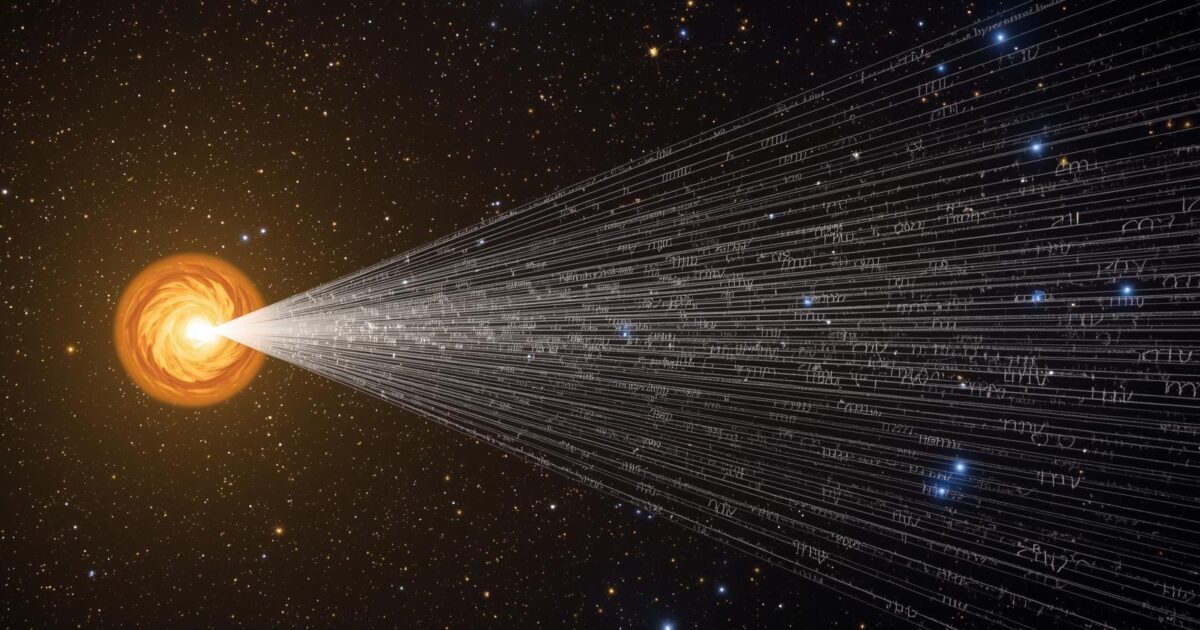
Les chasseurs de neutrinos
Les chasseurs de neutrinos Planétarium LUDIVER – Soirée conférence Rendez-vous le vendredi 10 octobre à 18h30 pour une conférence passionnante avec Valentin PESTEL, physicien au laboratoire de physique corpusculaire de Caen, qui...
Fête de la science 2025
Fête de la science 2025 Pour sa 34e édition, la Fête de la science sera tournée vers l’exploration des multiples formes d’intelligence A Caen, sur le campus 2 de l’université,...
 CNRS
CNRS
- Fertility and the environment, a tricky equationAs birth rates are declining the world over, economists have studied the impact of environmental concerns on fertility choices.
- Long-forgotten women's healthDesignated as Women's Health Month internationally, October is dotted with dedicated awareness campaigns and events. Yet health is another area in which women are victims of gender inequalities. Although research is finally taking an interest in the female body’s specific reactions to disease, clinical trials are only now beginning to include more women.
- Dwarf elephants and the CyclopesA million years ago, long before mass tourism, the Mediterranean islands were home to dwarf elephants. Although tiny when compared to their ancestors, these animals may have inspired the Greek myth of the Cyclopes.
- Windows to a dream worldVirtual globes, 2D or 3D representations of the world produced from digital data, can fool us into thinking that we now know everything there is to know about the Earth. But a deluge of data is no guarantee of a better picture of “reality”.
- Jacqueline Bloch, magician of lightThe outstanding physicist Jacqueline Bloch is a specialist in polaritons, microscopic objects halfway between matter and light. She has just been awarded the CNRS Gold Medal, France’s highest scientific distinction. A portrait.
UNICAEN
- Intelligence artificielle : la 2ème édition des Assises de l’IA donne la parole aux étudiants et étudiantesComment trouver sa place dans le monde du travail à l’heure de l’IA ? Pour intégrer au débat les professionnels de demain, les Assises de l’IA ont convié des étudiantes et étudiants de l’université de Caen Normandie.
- Dans le lait cru, une bataille invisibleLudovico Screpanti, doctorant en microbiologie au laboratoire ABTE, étudie les interactions entre les microoganismes du lait cru.
- Nouvelle offre de formations courtes pour entreprisesIntelligence artificielle, cybersécurité, management, QSE, ... Découvrez les nouvelles formations à destination des entreprises.
- City Healthcare : l’université de Caen Normandie mobilisée autour des enjeux du numérique en santéÀ l’occasion du salon City Healthcare qui s’est déroulé à Nantes le 06 octobre, l’université de Caen Normandie a mis en lumière son offre de formation et ses initiatives en faveur de l’innovation en santé numérique.
- Fermeture des campus 1, 2, 3 et 6 de Caen jusqu’au 18/10/2026Les campus 1 et 2 de Caen resteront fermés jusqu'au dimanche 18 octobre 2026.
- Fête de la Science : nos équipes restent mobiliséesLe Village des Sciences de Caen ne pourra finalement pas se tenir les 9 et 10 octobre, mais nos équipes restent mobilisées.